The challenges of oyster parks: between exploitation and preservation
Oyster farming areas, often located in sensitive coastal areas, must deal with major constraints: tides, irregular terrain and fragile infrastructure. These challenges make the management of concessions, the maintenance of facilities and the expansion of parks and basins difficult and complex. Accurate mapping is essential to preserve these ecosystems while maximizing production.
Concrete use case
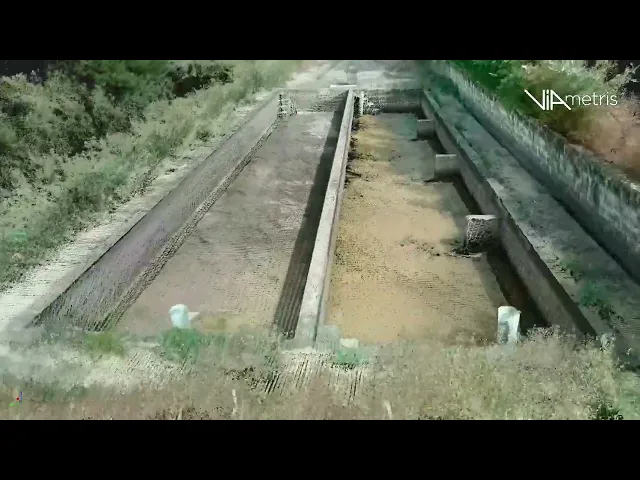
During a recent intervention on a French oyster pond, the MS-96 mapped a 1-hectare area including a building to be renovated in just 10 minutes. The data obtained made it possible to visualize the infrastructures in 3D, quickly identifying the areas requiring renovation or expansion. This efficiency simplified the planning of the works while minimizing costs.
The MS-96: An Advanced Technological Response
The MS-96, thanks to its millimeter precision and versatility, stands out as an ideal answer. Easily transportable in backpack mode, it allows rapid data collection even in difficult environments. Among its main advantages:
Quick Data Collection: cover large areas in record time, reducing field interventions.
Unprecedented Accuracy: generate dense 3D point clouds for detailed vision of installations.
Minimal Impact: reduced disturbance in environmentally sensitive areas.
Practical applications: management, maintenance and expansion
The use of MS-96 for oyster farming opens up many perspectives, both for daily management and for development projects:
Concession Management: accurate plot modeling allows for more efficient management and optimization of operations.
Environmental Monitoring: regular mapping allows for monitoring the state of ecosystems, anticipating natural hazards and adapting practices accordingly. For example, early detection of coastal erosion or changes in sedimentation can help prevent potential damage to parks.
Facility Maintenance & Renovation: thanks to the accuracy of the data collected, it is possible to quickly locate areas requiring repair or modernization, thus helping to extend the life of oyster equipment.
Pond Expansion: for expansion projects, the MS-96 provides detailed information on the areas to be developed, facilitating the process and planning.
Future prospects
The use of MS-96 in oyster farming opens the way to new possibilities. Integrating this precise data with other technologies, such as artificial intelligence or drones for complementary aerial surveillance, could revolutionize the management of oyster beds. In addition, this high-resolution data is a valuable resource for scientific research, allowing a better understanding of coastal ecosystems and the impact of oyster farming practices on the environment.

